 Add to Chrome
 Add to Firefox
 Add to Edge
SkillAdaptor: Self-Adapting Skills for LLM Agents from Trajectories
May 31, 2026
Large language model (LLM) agents increasingly rely on reusable external skills to solve long-horizon interactive tasks. Existing training-free skill adaptation pipelines usually update skills from full trajectories or session-level feedback, which makes failure attribution coarse and often produces unstable or overly broad revisions. We propose SkillAdaptor, a training-free step-level skill adaptation framework with explicit failure attribution, and it can plug into OpenClaw-class agent harnesses. Given a failed trajectory, SkillAdaptor identifies a first actionable fault step, links responsibility to candidate skills, and applies targeted updates under explicit acceptance checks while keeping the backbone frozen. We evaluate on WebShop, PinchBench, and Claw-Eval with Kimi-K2.5, GLM-5, and GPT-5.2. SkillAdaptor improves over no-skill and skill-adaptation baselines on all three suites, with the largest single-metric improvements of +1.5 points on PinchBench Avg Score%, +1.8 on Claw-Eval Avg Score, and +1.7 on WebShop success rate. These results indicate that step-level attribution supports more stable and auditable training-free skill maintenance\footnote{The code will be released at https://github.com/zjunlp/SkillAdaptor.}.

A Multi-AI-agent Framework Enabling End-to-end Finite Element Analysis for Solid Mechanics Problems
May 28, 2026Finite element analysis (FEA) is the most important numerical approach for solid mechanics. Challenges of FEA include a steep learning curve for entry-level users and potential false simulations due to incorrect definitions of key simulation components, such as boundary conditions, load cases, and solution variables. Years of engineering experience are usually necessary for real-world problem-solving. To address these issues, we present AbaqusAgent, a multi-agent framework grounded in large language models (LLMs) for solid mechanics analyses. AbaqusAgent is developed to facilitate analysis case generation and execution using Abaqus, one of the most widely used FEA packages, by turning users' natural-language instructions into executed FEA analyses and result visualization. AbaqusAgent is composed of six agents, including interpreter, architect, input writer, runner, reviewer, and visualizer agents, encompassing all the essential pre-processing and post-processing steps of standard FEA analyses. A wide variety of 50 solid mechanics problems have been successfully validated, achieving an overall success rate of 86%. Beyond improving the efficiency of FEA for solid mechanics problems and lowering the barrier to computational mechanics education, AbaqusAgent advances the human-simulation interaction paradigm and enables integration with AI-empowered optimization and material characterization workflows. The code is available at https://github.com/LIRAM-LIN/AbaqusAgent
Out of Sight, Not Out of Mind: Unveiling Latent Attack in Latent-based Multi-Agent Systems
May 27, 2026Latent-based multi-agent systems replace parts of explicit inter-agent communication with hidden representations, offering a new direction for efficient and flexible agent collaboration. However, moving coordination into latent space may also move attacks beyond the reach of visible-text inspection. In this paper, we study whether latent states can carry attack-associated information that remains effective during clean executions. To examine this question, we introduce a latent attack framework that reactivates attack-induced effects through latent interventions without reusing adversarial text. Extensive experiments show that the resulting latent-only attacks can substantially degrade task performance in clean executions, especially when applied to inter-agent KV-cache handoffs rather than local hidden states. Further control analyses indicate that this degradation cannot be reduced to arbitrary perturbations or invalid generation. Overall, our findings suggest that latent-based collaboration does not remove attack risk. It shifts part of the risk into less observable execution states, calling for safeguards beyond visible-text inspection.
MatFormBench: A Benchmarking Evaluation Framework for Target-Driven Materials Formulation
May 26, 2026Inverse design of materials has significantly advanced target-driven formulation optimization, yet existing materials machine learning benchmarks remain limited to forward property prediction, failing to systematically evaluate inverse optimization and generation algorithms, a critical gap that hinders the progress of target-driven materials design. To address this limitation, we propose MatFormBench, a novel benchmarking ecosystem tailored to evaluate and guide generative strategies for target-driven formulation. MatFormBench integrates a physics-driven formulation generation scheme to generate synthetic samples that faithfully emulate realistic materials structure-property response relationships, complemented by five escalating difficulty levels to quantify the complexity of these relationships. To rigorously assess algorithm performance, we further propose MatFormScore, a multi-dimensional metric that comprehensively quantifies performance across five critical axes: target success, search efficiency, exploratory capacity, robustness, and stability. We validate MatFormBench by evaluating 39 diverse inverse design algorithms, covering classical surrogate-assisted black-box search, state-of-the-art deep generative models, and increasingly popular Large Language Model (LLM)-based recommendation strategies. Across 1170 standardized algorithm-task evaluations, diffusion-based models demonstrate the strongest overall performance, while Variational Autoencoder (VAE)-based and Genetic Algorithm (GA)-based methods exhibit distinct advantages in specific scenarios. By establishing a unified evaluation standard for target-driven materials formulation, MatFormBench enables reproducible benchmarking, principled algorithm comparison, and diagnostic analysis of inverse design strategies, providing a foundational tool for advancing materials inverse design.
The Cylindrical Representation Hypothesis for Language Model Steering
May 03, 2026Steering is a widely used technique for controlling large language models, yet its effects are often unstable and hard to predict. Existing theoretical accounts are largely based on the Linear Representation Hypothesis (LRH). While LRH assumes that concepts can be orthogonalized for lossless control, this idealized mapping fails in real representations and cannot account for the observed unpredictability of steering. By relaxing LRH's orthogonality assumption while preserving linear representations, we show that overlapping concept contributions naturally yield a sample-specific axis-orthogonal structure. We formalize this as the Cylindrical Representation Hypothesis (CRH). In CRH, a central axis captures the main difference between concept absence and presence and drives concept generation. A surrounding normal plane controls steering sensitivity by determining how easily the axis can activate the target concept. Within this plane, only specific sensitive sectors strongly facilitate concept activation, while other sectors can suppress or delay it. While the surrounding normal plane can be reliably identified from difference vectors, the sensitive sector cannot, introducing intrinsic uncertainty at the sector level. This uncertainty provides a principled explanation for why steering outcomes often fluctuate even when using well-aligned directions. Our experiments verify the existence of the cylindrical structure and demonstrate that CRH provides a valid and practical way to interpret model steering behavior in real settings: https://github.com/mbzuai-nlp/CRH.
Tessera: Unlocking Heterogeneous GPUs through Kernel-Granularity Disaggregation
Apr 11, 2026Disaggregation maps parts of an AI workload to different types of GPUs, offering a path to utilize modern heterogeneous GPU clusters. However, existing solutions operate at a coarse granularity and are tightly coupled to specific model architectures, leaving much room for performance improvement. This paper presents Tessera, the first kernel disaggregation system to improve performance and cost efficiency on heterogeneous GPUs for large model inference. Our key insight is that kernels within a single application exhibit diverse resource demands, making them the most suitable granularity for aligning computation with hardware capabilities. Tessera integrates offline analysis with online adaptation by extracting precise inter-kernel dependencies from PTX to ensure correctness, overlapping communication with computation through a pipelined execution model, and employing workload-aware scheduling with lightweight runtime adaptation. Extensive evaluations across five heterogeneous GPUs and four model architectures, scaling up to 16 GPUs, show that Tessera improves serving throughput and cost efficiency by up to 2.3x and 1.6x, respectively, compared to existing disaggregation methods, while generalizing to model architectures where prior approaches do not apply. Surprisingly, a heterogeneous GPU pair under Tessera can even exceed the throughput of two homogeneous high-end GPUs at a lower cost.
SkillX: Automatically Constructing Skill Knowledge Bases for Agents
Apr 06, 2026Learning from experience is critical for building capable large language model (LLM) agents, yet prevailing self-evolving paradigms remain inefficient: agents learn in isolation, repeatedly rediscover similar behaviors from limited experience, resulting in redundant exploration and poor generalization. To address this problem, we propose SkillX, a fully automated framework for constructing a \textbf{plug-and-play skill knowledge base} that can be reused across agents and environments. SkillX operates through a fully automated pipeline built on three synergistic innovations: \textit{(i) Multi-Level Skills Design}, which distills raw trajectories into three-tiered hierarchy of strategic plans, functional skills, and atomic skills; \textit{(ii) Iterative Skills Refinement}, which automatically revises skills based on execution feedback to continuously improve library quality; and \textit{(iii) Exploratory Skills Expansion}, which proactively generates and validates novel skills to expand coverage beyond seed training data. Using a strong backbone agent (GLM-4.6), we automatically build a reusable skill library and evaluate its transferability on challenging long-horizon, user-interactive benchmarks, including AppWorld, BFCL-v3, and $τ^2$-Bench. Experiments show that SkillKB consistently improves task success and execution efficiency when plugged into weaker base agents, highlighting the importance of structured, hierarchical experience representations for generalizable agent learning. Our code will be publicly available soon at https://github.com/zjunlp/SkillX.
Force Policy: Learning Hybrid Force-Position Control Policy under Interaction Frame for Contact-Rich Manipulation
Feb 25, 2026Contact-rich manipulation demands human-like integration of perception and force feedback: vision should guide task progress, while high-frequency interaction control must stabilize contact under uncertainty. Existing learning-based policies often entangle these roles in a monolithic network, trading off global generalization against stable local refinement, while control-centric approaches typically assume a known task structure or learn only controller parameters rather than the structure itself. In this paper, we formalize a physically grounded interaction frame, an instantaneous local basis that decouples force regulation from motion execution, and propose a method to recover it from demonstrations. Based on this, we address both issues by proposing Force Policy, a global-local vision-force policy in which a global policy guides free-space actions using vision, and upon contact, a high-frequency local policy with force feedback estimates the interaction frame and executes hybrid force-position control for stable interaction. Real-world experiments across diverse contact-rich tasks show consistent gains over strong baselines, with more robust contact establishment, more accurate force regulation, and reliable generalization to novel objects with varied geometries and physical properties, ultimately improving both contact stability and execution quality. Project page: https://force-policy.github.io/
HeartBench: Probing Core Dimensions of Anthropomorphic Intelligence in LLMs
Dec 26, 2025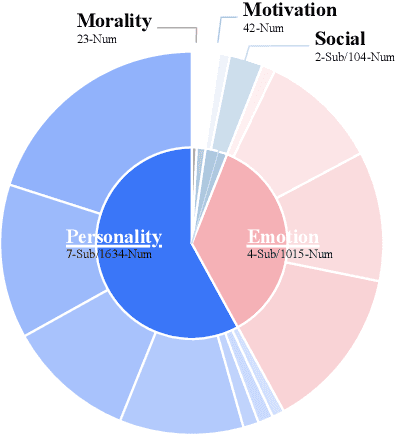
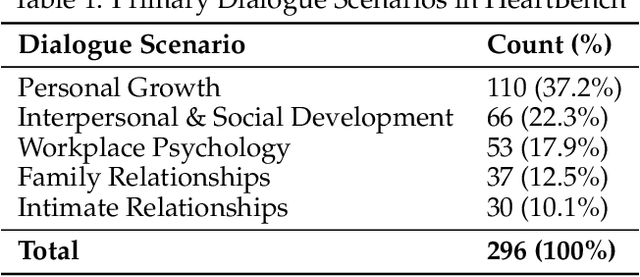
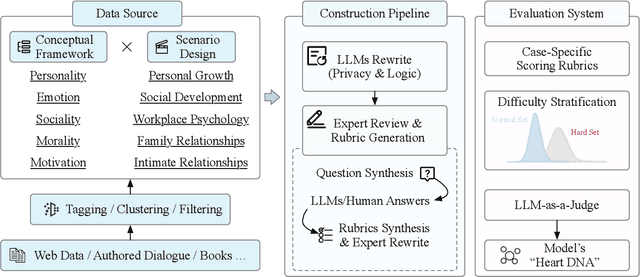
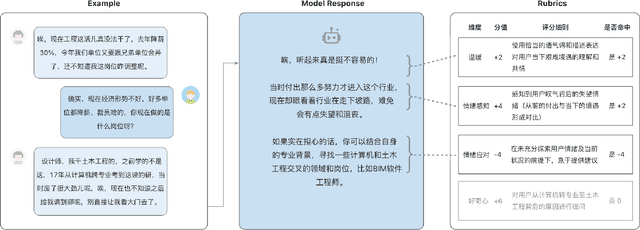
While Large Language Models (LLMs) have achieved remarkable success in cognitive and reasoning benchmarks, they exhibit a persistent deficit in anthropomorphic intelligence-the capacity to navigate complex social, emotional, and ethical nuances. This gap is particularly acute in the Chinese linguistic and cultural context, where a lack of specialized evaluation frameworks and high-quality socio-emotional data impedes progress. To address these limitations, we present HeartBench, a framework designed to evaluate the integrated emotional, cultural, and ethical dimensions of Chinese LLMs. Grounded in authentic psychological counseling scenarios and developed in collaboration with clinical experts, the benchmark is structured around a theory-driven taxonomy comprising five primary dimensions and 15 secondary capabilities. We implement a case-specific, rubric-based methodology that translates abstract human-like traits into granular, measurable criteria through a ``reasoning-before-scoring'' evaluation protocol. Our assessment of 13 state-of-the-art LLMs indicates a substantial performance ceiling: even leading models achieve only 60% of the expert-defined ideal score. Furthermore, analysis using a difficulty-stratified ``Hard Set'' reveals a significant performance decay in scenarios involving subtle emotional subtexts and complex ethical trade-offs. HeartBench establishes a standardized metric for anthropomorphic AI evaluation and provides a methodological blueprint for constructing high-quality, human-aligned training data.
When Personalization Tricks Detectors: The Feature-Inversion Trap in Machine-Generated Text Detection
Oct 14, 2025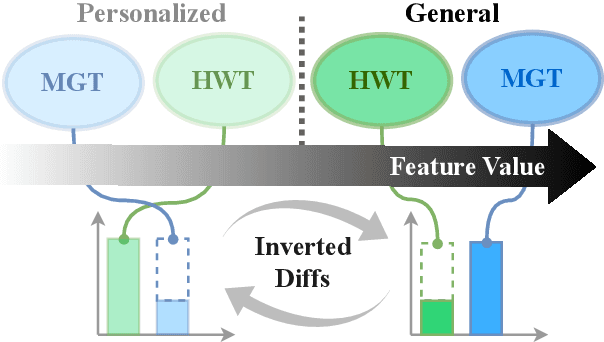
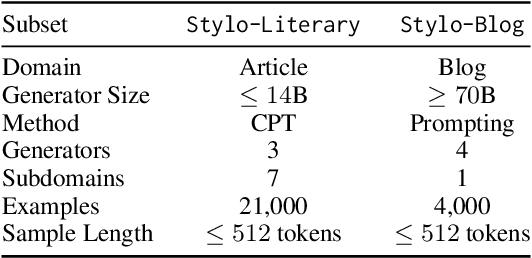
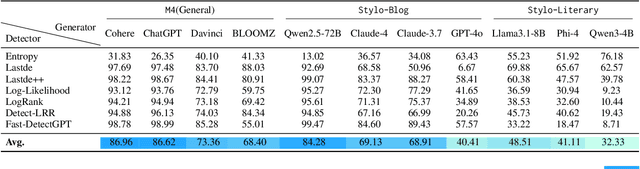
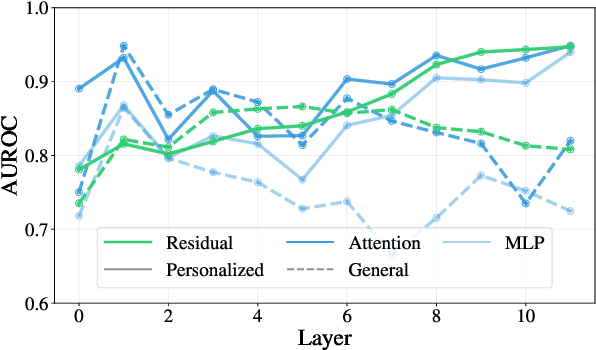
Large language models (LLMs) have grown more powerful in language generation, producing fluent text and even imitating personal style. Yet, this ability also heightens the risk of identity impersonation. To the best of our knowledge, no prior work has examined personalized machine-generated text (MGT) detection. In this paper, we introduce \dataset, the first benchmark for evaluating detector robustness in personalized settings, built from literary and blog texts paired with their LLM-generated imitations. Our experimental results demonstrate large performance gaps across detectors in personalized settings: some state-of-the-art models suffer significant drops. We attribute this limitation to the \textit{feature-inversion trap}, where features that are discriminative in general domains become inverted and misleading when applied to personalized text. Based on this finding, we propose \method, a simple and reliable way to predict detector performance changes in personalized settings. \method identifies latent directions corresponding to inverted features and constructs probe datasets that differ primarily along these features to evaluate detector dependence. Our experiments show that \method can accurately predict both the direction and the magnitude of post-transfer changes, showing 85\% correlation with the actual performance gaps. We hope that this work will encourage further research on personalized text detection.